

No method at all
The hospital ship as the product of a chaotic White House

Willard: They told me that you had gone totally insane, and that your methods were unsound.
Kurtz: Are my methods unsound?
Willard: I don’t see any method at all, sir.
-Apocalypse Now (1979)
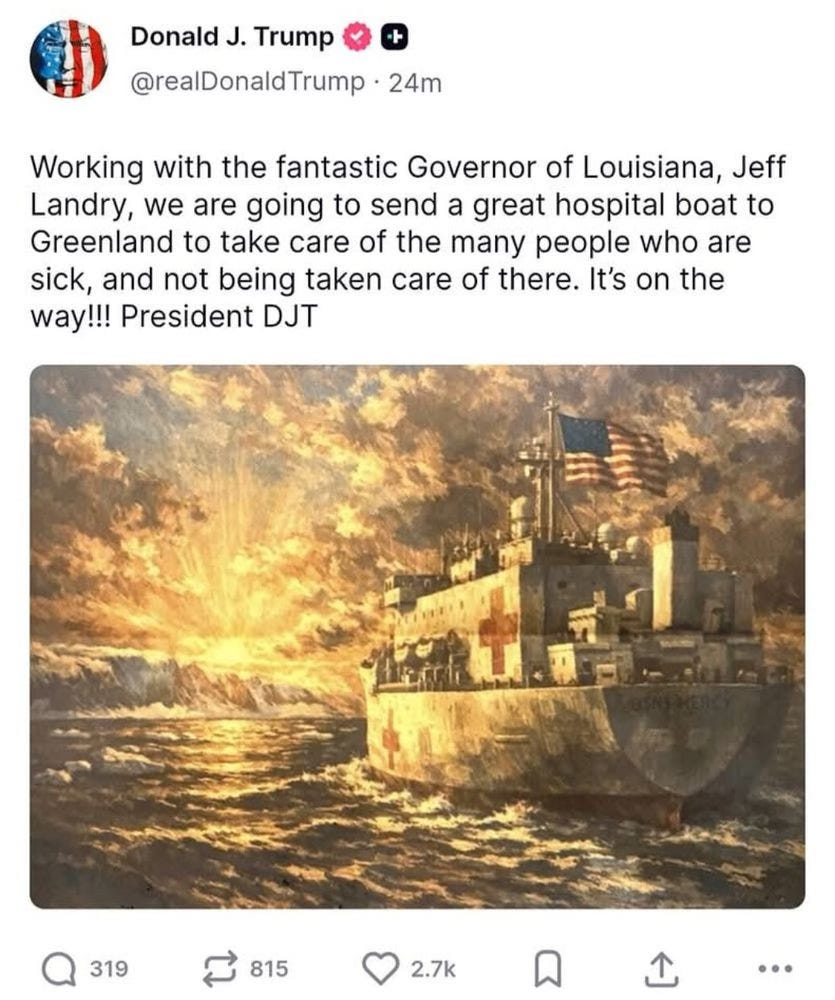
On Saturday night, President Trump announced on Truth Social that he was dispatching one of the U.S. Navy’s hospital ships to Greenland. This was apparently not in response to any request from Greenland or Denmark or any demonstrated medical need. But I happened to see this story right after finishing Ezra Klein’s interview with Atlantic journalists Ashley Parker and Michael Scherer, and it fits so neatly into the discussion about power in this White House.
The White House has evolved over time, especially since World War II, to have a fairly rigid organizational structure with pretty clear lines of responsibility. Obviously different presidents have approached this differently, and some prefer a less rigid organization. President Eisenhower, building off his military experience, established the first formal Chief of Staff position in 1953, and the holder of that office traditionally holds a great deal of power in managing the President’s time and determining who gets to talk to him and who doesn’t.1 Presidential time has generally been considered a precious resource, and the White House office typically wants to limit it to moments where the President’s input is vitally needed.
Trump, of course, is famously resistant to being managed. His first term was rife with stories of him refusing to let go of some issues despite strong pushback from his top aides, and some of them would even disappear papers from his desk to keep him from acting on bad ideas. It’s not been clear to me what current Chief of Staff Susie Wiles’ actual role is, but this was one of the interesting things in the Klein podcast. Scherer somewhat surprisingly described her as an actual Chief:
She was there with him during his time in the wilderness after Jan. 6, because she was able to build the campaign that ended up winning and because she has figured out her relationship with Trump — in a way that I don’t think anyone else who has ever worked with him has at that level — she is able to go to him and say: I don’t think that’s a good idea. And she is able to put people in front of him who say: I don’t think that’s a good idea.
I don’t think it’s a situation where he is not getting pushback. Now that doesn’t mean he always listens to her.
But overall, while Scherer and Parker were fairly diplomatic about it, they largely described this White House as a chaotic environment in which presidential time really isn’t managed at all. In their description, a typical Trump workday includes:
Calling and taking calls from friends, reporters, politicians and others for hours throughout the day, sometimes just picking up the phone not even knowing who is calling
Giving very lengthy interviews on TV and radio
Watching hours of Fox News
Posting extensively on his social media account
He is famously uninterested in intelligence and policy briefings, or, for that matter, Congress.
Trump, that is, seems to have more free time than almost any employed person I know. The workday in this White House seems to be that the President wanders around looking for something to get angry about, and then suddenly announces a solution to that problem by fiat without consulting with anyone familiar with the politics or policy.
The hospital ship is a great example of this. It sounds like Trump got wind (presumably via Gov. Landry) of a crew member on a U.S. submarine off Greenland needing urgent medical attention. The crew member was taken off the submarine and sent to a hospital in Nuuk. Trump quickly decided that there was in fact a substantial medical crisis in Greenland and that the U.S. would demonstrate its goodwill and importance to the island nation by sending a hospital ship there. Leaders of both Greenland and Denmark declined the help, saying it was unneeded and also that they, unlike the United States, have a good health care system where everyone is guaranteed care. It also turns out that neither of the U.S. Navy’s hospital ships are capable of sailing right now. But no matter.
I will confess to being somewhat annoyed at the work by Parker and especially Scherer in the Klein interview to portray this as just another way for a White House to function. (Scherer also said at one point that the President “does not prioritize being accurate.”) I sympathize to some extent — a White House reporter who regularly describes the President as a liar and the White House as a chaotic mess, even if those things are true, will not be granted many interviews or much access. But I believe these euphemisms do readers a real disservice.
But another notable takeaway is just how much influence this President seems to have amidst such disorganization. Like many other political scientists, I have been teaching for decades about how the presidency is a fairly weak office, requiring relationships and negotiations with Congress, deft management of an often recalcitrant bureaucracy, and good standing with the American public to accomplish much of anything. Trump has turned that on its head, drastically changing immigration policy, tariffs, policing, foreign relations, and more just by issuing executive orders or, more often, informal edicts.
The caveat there is that this governing style is not very effective in the long run. The Supreme Court has overturned most of his tariffs. The public has massively pushed back on immigration enforcement, compelling a retreat. Longstanding U.S. allies are looking for other partners.
But in the short run, one president with a bee in his bonnet and little care for how it looks publicly can do a hell of a lot of damage.
President Carter thought he could get by without a Chief of Staff but then hired one (Hamilton Jordan) halfway through his term. After the Democrats got wiped out in the 1994 midterms, one of President Clinton’s responses was to hire a stronger Chief of Staff (Leon Panetta) who could make the place run more efficiently.
Joseph Conrad’s Heart of Darkness 💙💙💙 “the horror” definitely sums up this international crime syndicate regime 🤬🤬
Oy....the cut of his jib.