

"We will not wait!"
The left is on the rise in Democratic primaries, and the establishment hasn't really sold itself

The Democratic Party is currently enmeshed in a factional struggle that’s driving many primary election fights, ending a number of long political careers, and potentially transforming the party’s coalition of supporters. On one side are progressive & Democratic Socialist challengers who declare that the party’s “establishment” isn’t doing enough to meet the challenges of the moment. On the other are establishment figures who declare that handing the party to the left will make the party unelectable. I want to talk about just what’s going on here and the merits of each side’s claims.
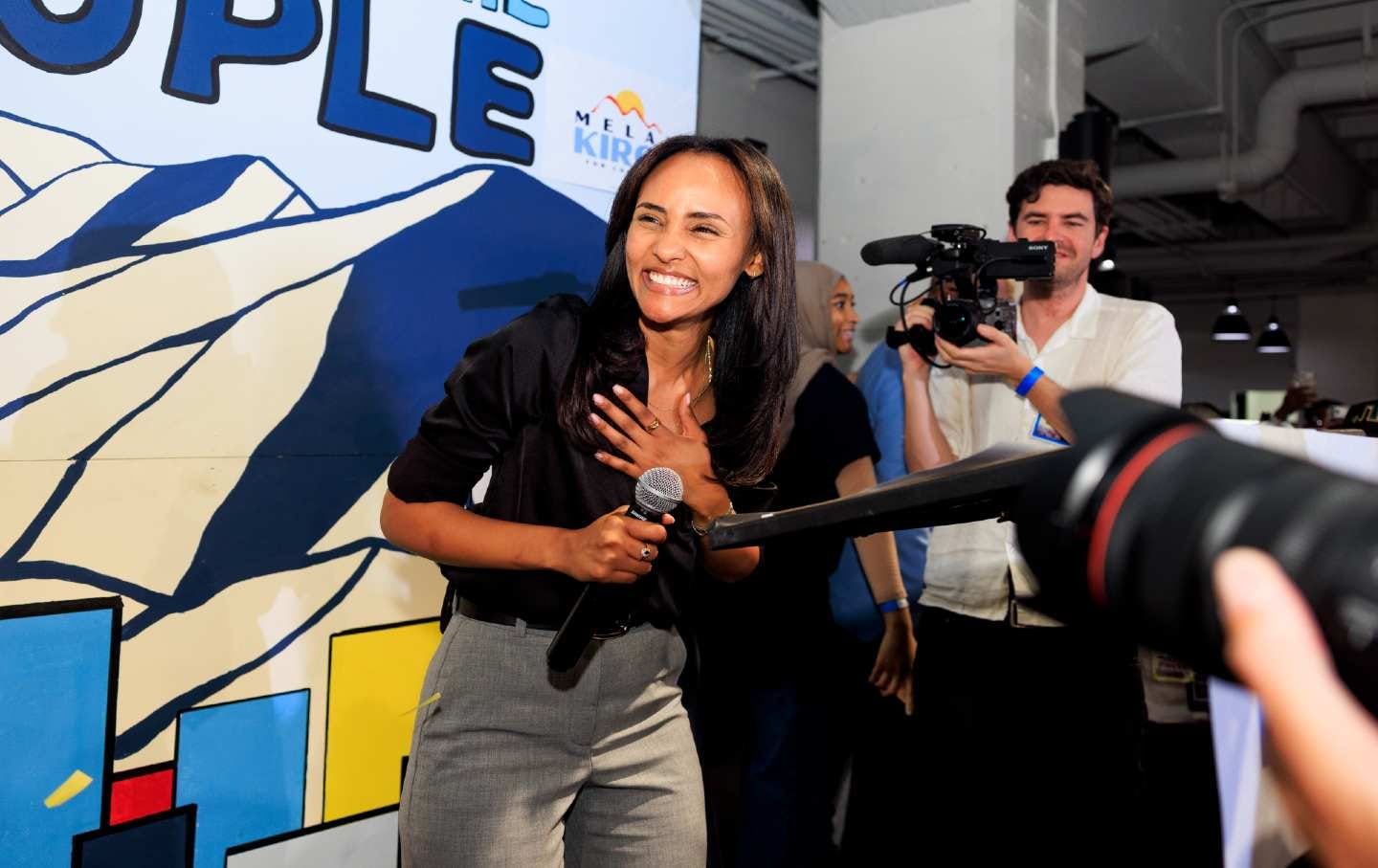
We’ve seen an impressive surge of candidacies on the Democratic left this year. (I’m just going to use the term “left” to encompass the Democratic Socialists, progressives, and others for the sake of convenience. I’m also going to use the term “establishment” to encompass most current Democratic incumbents, along with the DSCC, DCCC, the DNC, etc., also for convenience.) This have included a number of significant challenges to establishment candidates in Colorado, resulting, for example, in 30-year House veteran Diana DeGette losing her primary to political newcomer Melat Kiros. We saw a number of left challenges in New York’s Democratic primaries, as well, leading to, among other things, Brad Lander defeating Rep. Dan Goldman and Darializa Avila Chevalier defeating Rep. Adriano Espaillat. There has been an unusually (if not dramatically) high number of state Democratic incumbents losing to left primary challengers in state legislative races this year, as well.
My impression is that the establishment side didn’t take most of these challenges seriously enough early on, and their counter to them is to mostly complain that people calling themselves socialists are making the party unelectable. Rather belatedly, some on the establishment side are attempting to counter-organize. Julia Azari has a great rundown of what’s going on in Wisconsin’s gubernatorial Democratic primary contest, in which the establishment is trying to prevent the nomination of DSA candidate Francesca Hong, although they’re doing so in a very weird way by adding candidates rather than trying to consolidate the establishment vote.
So where is this left movement coming from? My impression of the left insurgency is that it’s driven by two main factors, both strongly tied to age:
Younger voters have no political memory of the Cold War. People over 45 or so grew up in a political system that associated socialism with communism, the USSR, and evil. Younger people are just not so afraid of it, and haven’t seen much in recent years to impress them that capitalism is so much better. According to a YouGov/Cato Institute survey from last year, 62% of voters under the age of 30 have a favorable view of socialism, while only 32% of voters over 65 feel this way. So to a younger Democrat, a candidate calling themselves a Democratic Socialist just doesn’t sound all that disqualifying.
The Israel/Gaza War continues to be a highly salient and divisive issue in U.S. politics and especially within the Democratic Party. This is also about age, with younger, more liberal voters increasingly frustrated that there hasn’t been space in the political system to criticize Israel and the U.S.’s military support for it. (If you’re under 45 or so, Benjamin Netanyahu has been a dominant figure in Israeli politics for pretty much the whole time you’ve been politically conscious.) A politically active anti-Israel left within the Democratic Party is the result of that, and many leftist candidates and their supporters cite opposition to U.S. support for Israel as one of their main animating reasons for entering politics.1
Now, one of the main complaints that these left candidates have of the establishment is that it’s not doing enough about the current crisis in government. It’s not necessarily that the establishment’s priorities or policies are wrong, but rather that they’re not fighting hard enough for them or recognizing the seriousness of the hour. (This is in some ways evocative of the Tea Party challengers in Republican primaries in 2010, who were not so much upset with the party’s agenda as they were with the urgency with which they were fighting for it.) As Kiros said in her victory speech:
We will not wait to take the fight to Donald Trump and the oligarchy. We will not wait to abolish ICE and pass Medicare for All. We will not wait to put an end to the politics of the past, to get big money out of our politics, and to reject corporate PACs and AIPAC. And no, we will not wait to end the genocide in Palestine.
These criticisms seem pretty consistent across a lot of left challengers this year. Now importantly, they ignore a number of things the establishment is actually doing in office, including forcing government shutdowns, derailing a number of Trump nominations, blocking bills to use as leverage, and more. And Chuck Schumer and Hakeem Jeffries deserve credit for keeping their caucuses in line for this agenda. But it is inherently an inside baseball agenda; it’s about slowing Trump and Republicans down rather than creating something new, and it’s inherently hard to observe. This is not material that inspires younger left-leaning Democrats.
As for the establishment, what do they have to say in their defense? Mainly, that the left will hurt the party in general elections. That is, the left has an electability problem, and it hurts not just in their own races but also for the party nationally. As two leaders from Third Way argued, the DSA’s agenda is “electoral poison.”
Now, the evidence on that is far from clear. Benjamin Highton and Erik Engstrom found in a recent study that more extreme U.S. Senators tend to have higher approval ratings than more centrist ones. As John Sides summarizes, other studies on this topic are mixed, with some finding that the advantages of moderation have declined somewhat in recent decades but are still important, and others finding no real advantage for moderates at all.
I’ll also highlight a telling point in that Third Way op/ed when they’re describing leftist pressure in 2020:
We found that “defund the police,” a slogan few Democratic candidates endorsed, helped lead to a dozen unexpected House losses for the party. The DSA’s rise could do the same. Every viral statement or nutty policy from a socialist will become a mailer in the swing districts where majorities are built. [emphasis added]
The claim is that the party was substantially hurt by words that almost no candidate uttered. Now, I’m highly skeptical of the conclusions of that study, but even if that were true, what exactly is the plan to deal with it? Somehow silence every socialist in the country? Of course Republican campaigns and aligned media are going to try to portray Democrats as extremists and use any vaguely leftist quote as evidence to support that. That literally happens in every election. That doesn’t mean that tactic always works, and it doesn’t mean that the only way to remedy it is to silence all dissent on your side.
At any rate, this leftist faction within the Democratic Party clearly has some significant energy behind it and is winning some primaries. It’s not about to take over the party, but it’s also not a faction that the establishment can ignore right now.
This is, to a significant extent, a populist surge, similar in some ways to the one that took over the Republican Party in recent years. And one thing we know about populists is that they aren’t terribly receptive to orders from party insiders. But beyond that, “You may not be inspired by us, but voting for people who are saying what you want to hear could maybe sort of hurt us in November” is not a hell of a rallying cry.
Are criticisms of Israel inherently antisemitic? No. Do some criticisms cross over into antisemitism? Yes. I’ll have more to say on this in a later post.
"Of course Republican campaigns and aligned media are going to try to portray Democrats as extremists and use any vaguely leftist quote as evidence to support that. That literally happens in every election."
This is a take I've had for a while, especially with the rise of social media. Republicans can and will take quotes from accounts with ones of followers and use this cherrypicked evidence to make wild claims. In contrast, Democrats use the words of the literal party leaders and the retort is that they "cannot take a joke." I might be beating a dead squid, but with January 6th, the lead up to that saw the primary spreaders of misinformation almost entirely arising from the GOP elite, as thoroughly documented by Ian Kennedy and their colleagues at the University of Washington (https://journalqd.org/article/view/3137). While it will be important to be vigilant so as to prevent people like Platner from claiming the mantle of the new left, I personally am getting tired of the empirically questionable and vibes based electability argument.
This nicely organized analysis of survey results shows that pretty much everyone everywhere shares the DSA goals. https://gelliottmorris.substack.com/p/what-do-voters-in-each-congressional