

The case for Democratic recklessness, redux
The Democrats also doing mid-decade redistricting would be chaos. It's also the only way out of this situation.

Back in 2017, I wrote a piece for Pacific Standard called “The Case for Democratic Recklessness.” It was written at a time when Democrats were in the minority and were daily horrified by the norm-shattering actions of the new Trump administration, and also by the more longstanding willingness of congressional Republicans to put the economy and the political system at risk. (Sound familiar?) My suggestion at the time was that Democrats should behave more like Republicans — not out of meanness or revenge, but because that was the only way to make the country more functional in the long run. I want to walk through this idea a bit here, as it seems quite relevant today.
I grounded the piece by dusting off some old grad school notes from a game theory class:
In a prisoner’s dilemma, two players are competing against each other, and each has just two options — cooperate or defect. If they both cooperate, they both get a nice reward (say, $1 each). However, if Player 1 defects while Player 2 cooperates, Player 1 gets an even bigger reward while Player 2 pays a penalty. (The reverse happens if Player 1 cooperates while Player 2 defects.) If both players defect, neither gets a reward nor pays a penalty. Thus, each player wants the other to cooperate, and both prefer jointly cooperating to both defecting. But since each can’t trust the other to cooperate, the usual outcome is for both to defect, leading to no payoff for either player. (The ferryboat scene in Dark Knight remains my favorite example of the prisoner’s dilemma, but there are plenty of others out there.)
Playing this game many times, though, can lead the players to develop norms of trust. Neither is happy with the low payoff, so reaching some sort of agreement about cooperation can be beneficial to both.
This hasn’t been the pattern in Congress. On a range of issues and tactics, Republicans have defected while Democrats have cooperated. This leads to a greater payoff for Republicans, whether we’re talking about election results or policy preferences. It means that the Congress slowly but steadily becomes less representative of the nation it represents. And, more generally, it means that the institution becomes worse. When institutional norms are repeatedly violated without penalty, it means those norms are functionally impotent; further norm violations become even more likely.
As I noted back then, we might expect public opinion to exert some moderating pressure on Republicans, but only some. The next election is more than a year away, and voters rarely cast votes to punish officeholders on budget votes, or extremist rhetoric, or erosion of congressional power.
So one application of this game theoretical problem would be in Republicans’ sudden interest in mid-decade redistricting. They’re pushing hard for a new Texas map to squeeze out five more Republican-friendly seats by next year, and they’re expanding this campaign into Indiana and other states. Several states doing this would make it a lot harder for Democrats to take control of the House next fall, even with a significant blue-leaning electorate on their side.
So this leaves Democrats struggling with what to do in response. Some have called out the Trump-backed redistricting campaign as unethical and un-American. Gene Wu, chair of the Texas House Democratic Caucus, implored people to stand up and call out the redistricting plan as wrong:
If Donald Trump is allowed to do this, if he is allowed to once again cheat and get away with it, there’s no stopping this. This will spread across the country, and… will occur everywhere. Because if one person’s going to cheat and no one’s going to stop it, why doesn’t everyone just do it then? And that is not a society, that is not an America that works.
Everyone is already tired of the hyperpartisan bickering and all the fighting because we never get anything done. And they are creating a system that will reinforce that and make it even worse. And we’re telling people, please come out, stand up against it, rise up and say no more. Enough.
This is certainly strong language. And Wu and his fellow Texas House Democrats are hardly just relying on rhetoric — they’ve fled the state to deprive the chamber of a quorum, and they’re risking substantial fines and even expulsion. But ultimately, what he’s advocating for here is for people to recognize that the Republican strategy is wrong and to bring them back to their senses.
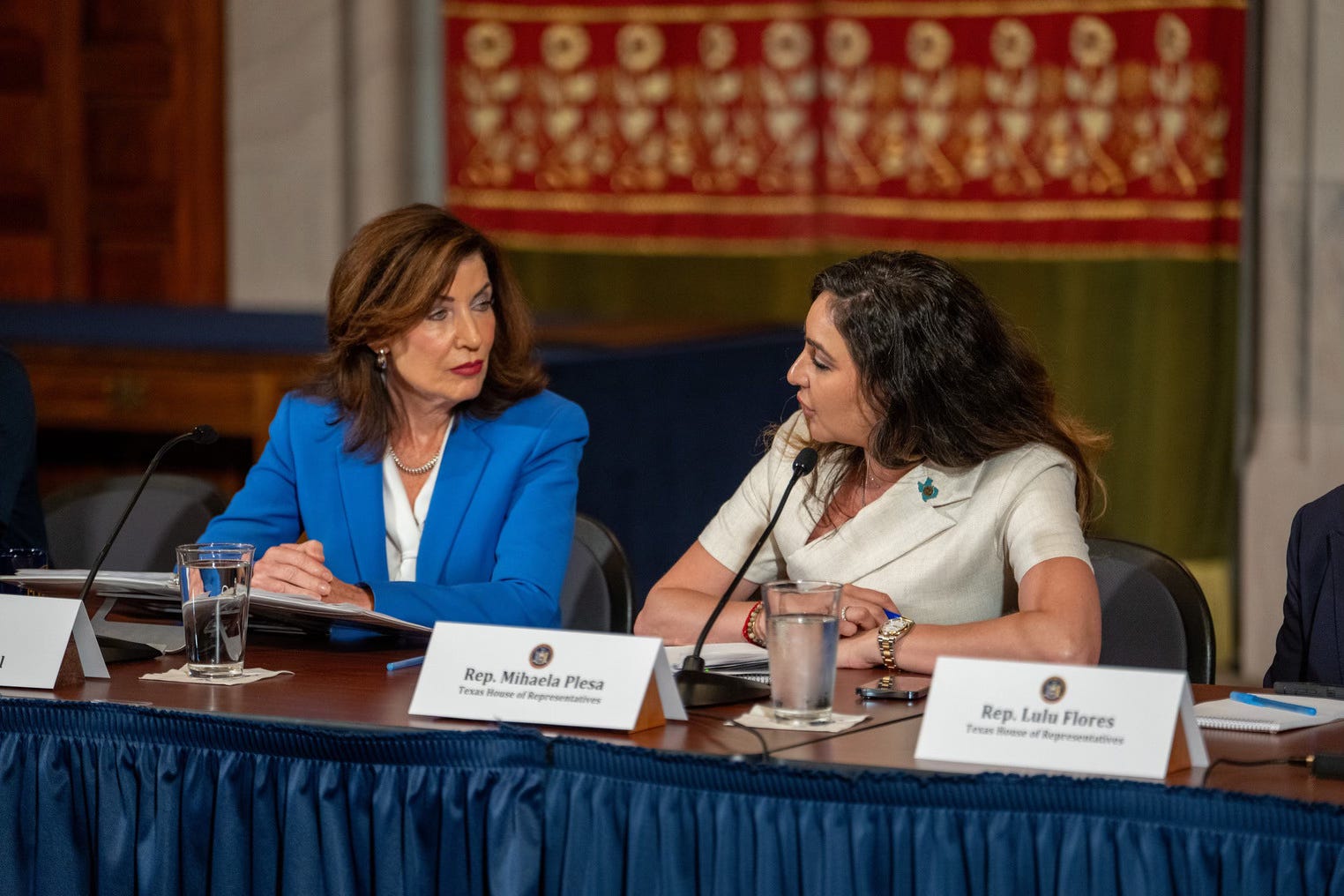
Another approach has been advocated by Governors Gavin Newsom (California) and Kathy Hochul (New York): do what the Republicans are doing. They have said that if the Texas plan goes ahead, they will seek to aggressively gerrymander their own states to give Democrats more seats. While there are real limits to what these states could produce even if these governors can pull this off, it would be a significant escalation.
As I wrote back in 2017, there is
an alternative version of the prisoner’s dilemma that spans many iterations. In this game, it may make sense for one player to act irrationally in the short run, forgoing some payoffs, giving that player a reputation of unpredictability or even craziness. This can improve that player’s negotiating position further down the road. Arguably, Republicans have been pursuing this path for some time now. It could make sense for Democrats to adopt a similar strategy, at least to the point that Republicans believe that Democrats are as willing to damage the institution as they are.
If basically every state with unified party control starts redistricting multiple times a decade, yes, that would be chaos. Congressional incumbents would largely not like it, as it would make their own districts less predictable and more work to campaign in, and, in many cases, would increase their chances of losing the next election. Republican House members in Democratic states (and Democratic members in Republican states) certainly would complain about the risks of being redistricted out of their jobs. At that point, members of Congress from both parties would be incentivized to put a stop to it — passing laws prohibiting more than one redistricting per decade, or working with states to fundamentally reform how redistricting works, or to just reaching some agreement that they won’t go this way again. That is a potentially stable outcome, at least for a while.
But just one party behaving irresponsibly is bad for the whole system in the long run, and creates no path for things to return to functionality. You can’t make a party feel more reverent toward institutions and norms; you can raise the costs of irreverence. In the long run, that’s the most effective tool available.
Well, it may be inevitable, but I don't agree that it's good. The French Revolution is a good example of what happens with this sort of tit-for-tat. The Sieyes faction, which was supportive of the rule of law just got smaller and smaller until it basically disappeared. That's happening again here. The polarization is getting more and more intense and the result will be that if the Dems take control, the country will be nearly as bad--because their supporters will require it to be. "After all, those Repub bastards deserve it! The Dems are among the most despised parties in history! Why? Because they're punching bags! Gotta fight fire with fire!" Etc.
This effectively summarizes my response, written before I saw your post!
https://owenprell.substack.com/p/the-scourge-of-gerrymandering-and?r=3ncfs3