



This was a treat. I teamed up yesterday with ian silverii and Jason Bane at the Get More Smarter podcast (the top Democratic-leaning politics podcast in Colorado?) to discuss Tuesday’s primaries. You can watch/listen here, or tune into their podcast, but I want to describe a bit of what we learned here and offer some takeaways on what was a primary election with national consequences.
[Ed. note: I usually do a paywalled post on Thursdays, but I’m making this one free.]
One thing you’ll notice in this discussion is that I’m very much the political scientist and they’re very much the political consultants. That is, we mainly see eye-to-eye, but with different perspectives. I tend to attribute the primary results to some nationwide (even international) left-populist movement that’s spurring anger at Democratic incumbents; they tend to focus on the quality of the candidates and the campaigns. Honestly I think we’re both right! We’re just looking at different parts of the election.
Just to run through some of the primary elections and our quick takeaways:
Democratic Governor’s Primary: We all expected Sen. Michael Bennet to lose to Attorney General Phil Weiser by this point, but we didn’t expect it to be by 13 points (as of the latest numbers). To his credit, Weiser ran a very effective campaign, and while he and Bennet didn’t disagree on much, Bennet was seen as the more “institutional” or “establishment” candidate, and this was a bad year to be that. As Ian and Jason argue, Weiser had a compelling and catchy slogan (“Weiser for Governor, Bennet for Senate”), while Bennet struggled to develop any sort of compelling rationale for why he wanted to leave the Senate and become governor. They also suggested that Bennet left some real assets on the table — he could have given a great fiery anti-Trump speech on the floor of the US Senate (he’s good at that!) and used that in his messaging, but it never happened.
Republican Governor’s Primary: As of today, “high risk humanitarian” Victor Marx is slightly leading State Sen. Barb Kirkmeyer for the nomination, with far-right state Rep. Scott Bottoms far behind. That is, the least conventional candidate is slightly edging out the most conventional one. This was a hard one to predict, but I think we all expected Marx to do well in this Republican Party. (We disagreed on whether the national media’s mockery of Marx helped or hurt him in this race.) But if he’s actually becoming the nominee, this could be a wild general election. It could split the party. It could lead to an absolutely wild set of debates… or no debates at all
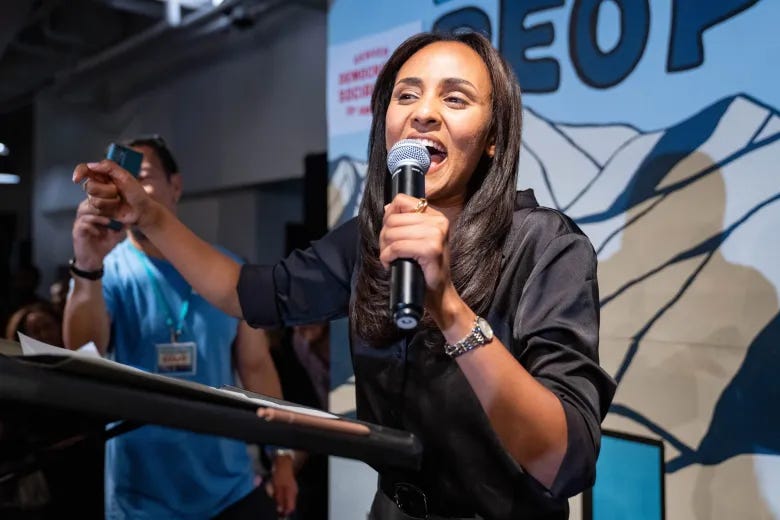
.The First Congressional District: This was the earthquake of Tuesday night, with 30-year incumbent Rep. Diana DeGette losing to 29-year old attorney Melat Kiros by 13 points. Kiros actually pulled 53% of the vote in a 3-way race. (I figured DeGette might hold onto her seat thanks to the split anti-establishment vote.) As Ian and Jason argue, DeGette was low-hanging fruit for a progressive challenge. She was pretty broadly respected as a very reliable Democratic vote in Congress — and a true fighter for reproductive freedom for many years — but she didn’t have a ton of strong allies, nor many constituents who loved her. And for what it’s worth, it’s hard to name a federal project in Denver with her name on it. She was also challenged by Kiros, who turned out to be a very strong campaigner. She’s clearly inexperienced, but also very intelligent and engaging, put a ton of shoe leather into this contest, and was backed by a strong Democratic Socialist team.
The Eighth Congressional District: We pretty broadly expected Manny Rutinel to defeat the more moderate Shannon Bird, although not by 30 points. He took a vote she took in the statehouse about ICE and made it an albatross around her neck. As Ian notes, the eight district was drawn not just to be competitive, but also heavily Latino, and Rutinel was successful at connecting with that constituency. We get into an embarrassing conversation about how handsome Rutinel is and whether that mattered.
The U.S. Senate primary: I express admiration of / frustration with John Hickenlooper, who has a remarkable win streak in Colorado politics, dating back to his two terms as Denver’s mayor and his two terms as governor, which he won in 2010 and 2014 — very hard years for Democrats. He is very difficult to beat (if you ignore his 2020 presidential run). So perhaps it’s no shock he beat back this left challenge from state Sen. Julie Gonzales. But as Ian and Jason note, Gonzales did not mount a terribly strong campaign. She was never able to raise that much money, she didn’t have much of a message or narrative for just why Coloradan’s should fire Hickenlooper or why they should hire her, and she seemed to do a lot of her campaigning solely in Denver.
We also get into the Attorney General race (Secretary of State Jena Griswold defeated the other three candidates handily, although by a plurality of the vote), and a shockingly expensive race in the 6th statehouse district, where a seemingly pretty progressive incumbent was taking down by a more progressive challenger. We also get into whether 2026 comprises a “Tea Party of the Left” year, and just how much candidate skill and campaign messaging matters. But it’s a really enjoyable run-down and I hope you’ll check it out.


