

Confederate Payback
How Trump's domestic troop deployments echo the language and goals of the southern redeemers

There is a standing army in the nation’s capital. The President deployed troops to Los Angeles earlier this year, and he’s now threatening to deploy some to Chicago, among other cities. People are struggling with the right way to think about this; I tend to view this as the ideological descendants of the Confederacy seeking payback against the Union.
Now, obviously, that’s not a perfect analogy. For one thing, this is being instigated by Donald Trump, a wealthy New Yorker (although a recent transplant to a former Confederate state).
But it’s important to recognize how much Trump, and the modern Republican Party more generally, has adopted Confederate tropes and ideology. In particular, Trump’s “stop the steal” campaign to overturn the results of the 2020 presidential election, up to and including the violence on January 6th, has been framed on the right as a “lost cause,” much as the Confederacy was after Robert E. Lee’s surrender in 1865. In this framework, the Reconstruction Era (1865-1877) was a period of humiliation for southern whites at the hands of occupying Union soldiers. To them, southern society was turned upside down during that era, with whites having to earn back their right to vote, and freed Blacks suddenly not only voting but holding public office. The “Redemption” era that followed was an effort by southern whites to set things right and return society to its proper order and hierarchies.
Also, as I noted here, you can view President Eisenhower sending Army solders into Little Rock in 1957 to integrate the public schools in a similar light. For many southern whites at the time, this was an abuse of military power and it was upsetting the order of things.
Jamelle Bouie has written extensively on this topic, as he did here in 2019:
What I’m struck by is how Trump is explicitly operating in the old American political tradition of race baiting… of denouncing blacks, immigrants and other hated groups to win votes and turn attention from the actual material agendas at work. This type of politics dominated the South from the end of Reconstruction until the civil rights era, electing generations of Southern politicians, including now obscure but once infamous names like Senator James K. Vardaman of Mississippi (in office from 1913 to 1919), Senator Ellison (Cotton Ed) Smith of South Carolina (in office from 1909 to 1944) and Gov. Eugene Talmadge of Georgia (who served 1933 to 1937 and 1941 to 1943). This is not ancient history by any means.
(For a thorough treatment of how white racial resentment links the eras of Reconstruction, civil rights, and Trump, definitely get yourself a copy of Julia Azari’s new book Backlash Presidents.)
Much of the motivating force behind Trump’s rise over the past ten years has been a form of white racial resentment and status anxiety. Whites who feel they are losing ground to immigrants and people of color tend to feel, as the redeemers did in the 1800s, that their society has been turned upside down. They follow Trump because they see him as the person who will properly restore things.
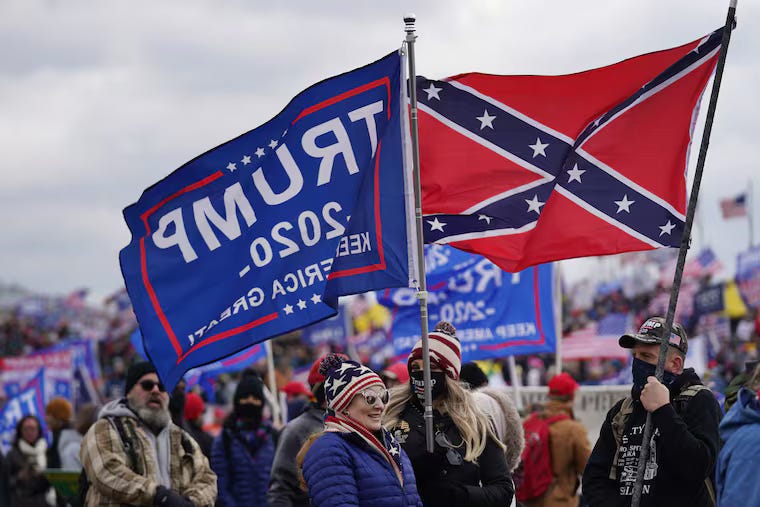
Trump and his supporters framed the 2020 election in a similar light to Reconstruction and forced integration. He repeatedly claimed, falsely, that it was a corrupt conspiracy to kick him out of the White House, and in the lead-up to January 6th, he rallied his supporters to try to set things right. And somewhat remarkably, the Confederate battle flag was along with him for the ride.
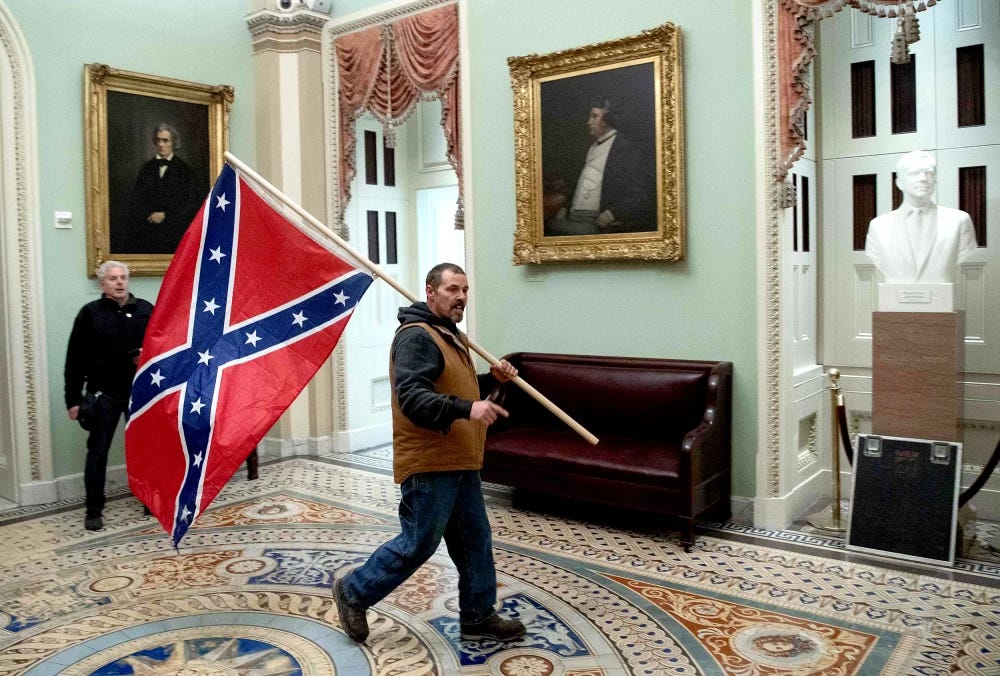
One of the more indelible images from January 6th was a rioter carrying a Confederate battle flag through the Capitol Building, something that had never happened before, and something that the Union Army successfully fought to keep from happening during the Civil War. A number of versions of the flag were flown outside the Capitol that day.
Similarly, the 2017 Unite the Right Rally in Charlottesville, Virginia — organized as a protest against the removal of a Confederate statue — featured Confederate battle flags; Trump famously defended the white supremacist demonstrators. Those resisting Covid restrictions in Michigan carried both Confederate and Trump flags.
How did that flag — the symbol of secession and slavery and white southern identity that was essentially opposed to everything the Republican Party stood for — become associated with a Republican New Yorker?
This is just the long story of American party transformation. The white South remained deeply Democratic for many years following the Civil War, with the party of Lincoln seen as an illegitimate occupying force. It would take over a hundred years, but these conservative white southerners would eventually see the the Democratic Party as too liberal for them, especially on race, and drifted toward the Republican Party. The passage of the Civil Rights Act and the Voting Rights Act, among other things, cemented the transformation of the Democratic Party from the party of secession to the party of civil rights. Confederate nostalgia thus became more associated with Republicans than with Democrats.
The resentment among many southern whites would remain, still directed, as it was in the 1860s, at Black Americans and those who championed their rights. What’s more, that resentment would spread outside of its original geography. It became common to see the Confederate battle flag show up in Republican areas of northern states wherever poorer white people were expressing resentment toward Blacks and feeling that they were losing ground and their status was being threatened.
You can find the flag in many rural areas of Ohio, among other northern states. Ohio contributed 320,000 soldiers to the Union cause during the Civil War — the highest per capita troop contribution of any Union state. Thousands of Ohioans gave their lives fighting the Confederacy. Yet the flag flies there today in many places.
It’s notable how the modern Republican Party has changed on this issue. In 2015, South Carolina’s Republican Governor Nikki Haley led the effort to remove the Confederate flag from the state capitol building. Just a few years later, Trump was defending the flag as a symbol of free speech and patriotism for southerners.
So back to what’s going on today. Trump has sent federalized National Guard soldiers into Los Angeles and Washington, DC, and promises to send them elsewhere soon:
You look at Chicago, how bad it is. You look at Los Angeles, how bad it is. We have other cities that are very bad. New York has a problem. And then you have, of course, Baltimore and Oakland. We don’t even mention that anymore. They’re so far gone.
Are these the cities with the highest crime rates? Not remotely. Are their crime rates spiking? No. What these cities have in common is Black mayors. Trump is trying to make an example of these cities. And in doing so, he’s exercising a form of revenge for the “humiliation” of Reconstruction and integration. The federal government occupied cities to hurt whites? He’s going to do the opposite.
This is the same administration that is purging the military’s leadership of women and people of color. The same one that is pressuring the Smithsonian to stop focusing on “how bad slavery was.” The same one that’s threatening the livelihood of colleges and universities unless they abolish all programs related to diversity, equity, and inclusiveness. The same one criticizing Cracker Barrel, a company built on small-town southern nostalgia, for going “woke” and abandoning its heritage. This is a redeemer government.
I'm glad to see that I am not crazy, because I have been seeing parallels between the Trump GOP and Confederate resurgence for many years. It seems Nancy MacLean was pretty clear about this in "Democracy in Chains", if not stating it in explicit terms, but also Atwater's Southern Strategy seemed to make the connection clear.
A friend living in Prague sent me a picture that was posted to one of their local FB groups around January 6th 2021 of a right-wing rally featuring Trump and Confederate flags.
Thanks for writing this. You make many points I've been mulling over in my head over time. A related one is what I've been calling the "bubba-ization" of American politics. Much of what Trump and his supporters are doing, or trying to do, would be unsurprising to anyone who read Key's _Southern Politics_ or, in general, was aware of how southern politics played out from Reconstruction until the rise of the "new South" in the 1960s/70s.
Also, I find it interesting that we're becoming familiar again with the Posse Comitatus Act, which was passed in 1878 to put teeth in the Hayes-Tilden bargain in the election of 1876: no more army occupation of the South. Now, we're facing an army occupation of the North. In this way, the Redemption analogy isn't perfect, since the Democratic Party wasn't able to use the U.S. Army or the federalization of state militias as its vehicle of Redemption.