

Arrested in L.A.
My interview with a fellow scholar who was recently arrested for participating in an anti-ICE protest

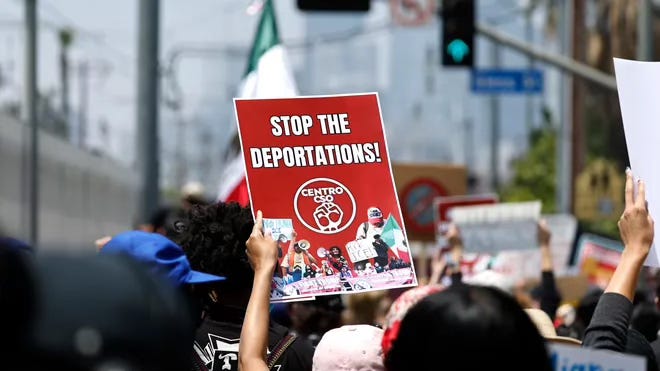
Earlier this week, a friend of mine – a fellow social scientist who is a local college professor – was arrested by the Los Angeles Police Department at a demonstration near downtown LA. They were not jailed or harmed, and they were able to get home early the next morning. But the story was nonetheless jarring, and I invited them to tell their story to me, reproduced below as a transcript. I have given my friend the pseudonym “CA” to protect their identity and insulate them from any (unlikely) reprisals.
Seth Masket: Thank you so much for doing this. In your own words, can you describe roughly what happened?
CA: I showed up to the anti-ICE protests at around 7:30PM. There was a sizable group in the street, but it was really on the small side… maybe 200-250 people. It was entirely peaceful. So there were a lot of press, a lot of people playing music. Absolutely no direct engagement with the authorities. The authorities were lined up, just rows and rows across Alameda and Second Street. A variety of protesters were kneeling in front of them. It was like that for a little while, after the dance party broke up.
Then the music stopped. People noticed that the officers started cornering off the cross streets. So I decided to walk backwards to 3rd Street, which was away from the action, away from all of the officers to just like check on things and ensure that we could still leave, and that they hadn’t kettled us in on all sides.
It was down to maybe 150 people. There was a row of officers. I asked if I could just get by to leave. They said no. I told them that I wanted to exit the area. They said that I couldn’t. I showed them that my car was right behind them, to the point that they could hear it when I hit my key fob.
And I said, “Well, I showed up to participate in a demonstration. I made my point. I want to leave now. Can I leave?” I asked them a few times. At which point I asked, “Are you going to arrest everyone?” and at first they said, “We will figure that out in a little while.”
And I said, “Well, if I’m trying to leave, on what grounds are you arresting everyone?” And they said, “Well, maybe we won’t arrest everyone.” And I said, “Okay, well, in that case, can I leave?” and they said no.
We were just continually asking the police, “Can we please leave? Can we please leave?” and they wouldn’t allow it.
We all walked to the back of the line, because at this point we were fully kettled in, and that’s when they gave the first orders to disperse. They started saying, “Leave the area” and marching forward. But there was at that point no way to actually leave the area. They wouldn’t let us clear, and they were just marching forward, marching south from Second to Third Street. They sandwiched us in.
We were just continually asking, “Can we please leave? Can we please leave?” and they wouldn’t allow it. Dozens of people were trying to leave at this point. I don’t know of a single person who was still trying to hold the line, and that’s the thing. It was a very small protest. I saw no engagement with the cops. I saw no physical engagement. I overheard somebody say they saw somebody threw a water bottle at some point. That was the one thing, and I heard someone say that, I didn’t see it.
SM: Were people yelling at the police, or anything like that?
CA: Early on, but they were yelling things like, “Get out of my city.” It was just standard protest. The protesters were chanting just the words “Peaceful protest,” literally up until the last person was arrested.
They made an announcement that we were all under arrest for failing to disperse. Everyone who I saw gave themselves over willingly, and so we kind of just made a line and got arrested one by one.
They put us in zip ties. This is around 8:30PM. They took our names, birthdays, the standard operating stuff like that, and put us in a police wagon. And then they took us to a jail in South Central where they processed just about everybody that night. One person tried to take his phone out while he was handcuffed to record, and they put him in jail.
SM: Did they take your phones from you?
CA: Yes, once we were handcuffed. They did a thorough pat down.
SM: Who was with you? What other sorts of people were there?
We were arrested with a bunch of press. There were a lot of photographers, a lot of journalists. They were very clearly identified.
CA: It was very much a mixed bag. Clearly the majority of people were from the Latino community for sure, and even then it spanned a really large gamut. There were some younger children there. On the bus with us was a minor, and we kept shouting at the cops, “This guy’s a minor. Be careful with what you’re filming. Be careful how you treat him.” It was only at the booking that they acknowledged that they had to treat him differently.
I was on the bus with a teacher from a local school who said she was there marching for her students. One of the people who we were sitting by was a public defender.
And we were arrested with a bunch of press. There were a lot of photographers, a lot of journalists.
SM: Were they clearly identified?
CA: They were very clearly identified. I have photographs of a guy in a full vest with a visible press pass getting arrested. They were yelling, “I’m press.” They were showing press badges. There were quite a few photojournalists there, and at least one reporter from CNN was temporarily detained as well.
SM: How were you treated once you were in their custody?
CA: I’m gonna come at this from a point of positionality. As someone they identified as white and female, and who self-identified as a college professor, I was treated reasonably well. But like with other people… I saw them rough-handling a few of the guys.
They gave people the opportunity to use the bathroom. There were cops walking around pouring water from the same water bottle into people’s mouths, which, I’ve never in my life more wanted to be thirsty to take that option.
SM: Did they eventually tell you what exactly you were being arrested for?
CA: Yeah. The charge was failure to disperse.
SM: And you were not jailed, correct.
CA: No, no. It was actually an outdoor holding area. It was enclosed by three walls and a fence. But it was fully outdoors. They had to march us through the jail to get us out. At no point we were jailed.
SM: How long were you there?
CA: I was cuffed at 8:30PM. And I, personally, was uncuffed at, I think, 1:30 in the morning.
SM: I’m particularly curious and disturbed about your accounts about the reporters being arrested. Did you have a sense of how this was affecting them, how they were treated at the booking area, how they described themselves?
CA: They very, very clearly identified themselves as press throughout. I saw later the CNN guy, who we watched get detained. They escorted them one by one, out of the protest. He was the only press that I saw not get arrested.
But they treated everyone in the press exactly the same as they treated everyone else. I didn’t see a single person who was press-identified actively participating in the protests. It’s not to say what their motivations were one way or the other. But I did not see it.
SM: I’ve not been in this situation, but I’m curious. Did anyone say to the police officers, “You can’t arrest press”?
CA: Oh yes, I did! I said, “You can’t arrest the press.” It didn’t seem to register. I said, “This is a violation of First Amendment rights. Arresting the press is a violation of everybody’s First Amendment rights.” The cops refuse to make eye contact with you. Which makes talking to them very, very difficult.
SM: Was this all LAPD? Did you see ICE officials or National Guard, or anyone else around?
CA: I only could see LAPD, just because of the sheer volume of them. I heard later that people saw National Guard, but I didn’t see them personally.
SM: So, the fact that police are arresting scholars and journalists at a peaceful protest is obviously really disturbing. I’m curious how you, as a social scientist, are feeling about this experience, how you’re reflecting on it. Is it making you rethink anything?
CA: I will say, as somebody who is very much a self-identified nerd, and who has never once broken either a city or parental curfew, I, too, have never been in this situation before. The thing that was most emotionally resonant to me was just seeing the interactions with the press in general. When I walked up to the protest, and I saw so many people in the press were wearing body armor. Steel-toed boots, very padded vests. Almost everybody I saw who had a press pass was wearing a helmet.
I had a good friend of mine call me the night of the 2016 election. And he said, “When do we know when to leave?” And my unequivocal answer was, “When the first journalist is arrested for being a journalist.”
Personally, I think this was way more disturbing than seeing skirmishes. I was expecting to see skirmishes. I didn’t see a single one. But that made me rethink things.
Many of us have over the last, you know, 8 to 10 years, in the process of watching what is unequivocally a democratic reversal… One asks themselves, okay, at what point do you think about leaving? What is what is the line?
I had a good friend of mine call me the night of the 2016 election. And he said, “When do we know when to leave?” And my unequivocal – without thinking, without pausing – answer was, “When the first journalist is arrested for being a journalist. Journalists are going to get arrested. They’re going to do some white collar crime. They’re going to participate in things, and they’re going to get arrested and happen to be journalists. But when the first journalist is arrested for being a journalist, I’m out.” And I was so sure that that was my line.
It made me rethink how comfortable I feel talking about our country to my students. I don’t work on U.S. politics, so I don’t have to change what I’m working on. But as somebody who works on conflict, in either new or failing or inchoate democracies, it made me feel like, the work that I do is tragically relevant. I am an inadvertent Americanist. I’ll change my CV.
The other thing I’m rethinking was the narrative that by the end of a protest, the people left are agitators — people who are there for something other than the cause. We hear it and easily accept it because we know that some people do exploit protests for chaos. I heard that about this protest the following day and it just wasn’t true. I realized that even I assumed that some of the people who are actually arrested were arrested because they disobeyed orders. To be clear, I believe that’s also a valid form of civic action, but it wasn’t my experience or that of the majority of people there.
That was really eye-opening for me and all the people we were with. We were all talking about how we assumed people had to do something to get arrested. Something more than showing up.
SM: Will this experience change your behavior going forward? Are you more or less likely to go to future protests?
CA: God, that’s such a good question. Because there were a lot of people who were like, “When are you getting back out there?” I’m not going to say that I’m spooked off of protests. I firmly believe in protest as a method of civic action.
There’s something that feels more secure about going to a large protest. I think it will be a minute before I attend a smaller one, and I’ll be much more aware of police moving to kettle in the protesters. That’s just something I’d never experienced before. It happened very, very quickly. If I saw a group of police officers congregating, I would be out in a flash. But I do think I am going to find myself thinking twice before I attend smaller protests again. I think that it will change my behavior in a way that will make me more cautious, but I’m not sure that I could identify exactly what my new set of decision rules are.
SM: So one last question for you. The behavior by the police you’re describing is almost certainly either illegal or unconstitutional, or both. And I’m curious: Would you seek any action, any sort of legal remedy, or anything at this point? Or do you just kind of want to let this one go?
CA: I wish I’d had the presence of mind to be filming, just because of the way that the police were carrying themselves. If, for example, the ACLU had my name from arrest records and found a way to contact me, I would say, yes, absolutely. I have just no doubt in my mind that what they were doing was unconstitutional. At the point that they gave they gave a dispersal order and we no longer had a way out. They started saying, “Clear the area,” and marching forward. But we were kettled in entirely. I said, “If you want, an officer can literally escort me, put their hands on me. That’s fine. Escort me to my car. It is already facing south, which is away from the protest. You can take me and my friends out one by one. There’s three of us, and we are asking to leave.” And that one guy said, “No, we’re just going to arrest you instead.” Those were his words exactly.
SM: Thank you for sharing this. I really appreciate it.
If they marched you through the jail to an outside holding facility, you were in fact jailed.
Sound to me like you and many others were illegally detained.
Thanks for sharing that story. It's no wonder some protesters become rioters. The choices made by the police are pushing them in that direction as exemplified by your friend thinking large demonstrations are safer than small ones. Two-thousand people are more apt to get rowdy than 200. The performative rioters are granted a bigger stage, more attention, and also enjoy some safety in numbers.