

2016 doesn't happen without 2012
Finding the point where the Republican Party became a home for Trump

In the book I’m working on, I’m wrestling with the question of whether Donald Trump transformed the Republican Party or whether the party had already changed to become a place that would welcome him before he got there. The answer, of course, is a little bit of both. But identifying those changes that preceded Trump is interesting. In many ways, the 2012 election tells us more about the transformation in the GOP than 2016 does.
One of the most important shifts in the electorate in recent years has been the movement of “working class whites” out of the Democratic Party and into the Republican coalition. Some version of this has been going on for a long time; it was happening in southern states in the middle of the 20th century. As the national Democratic Party began to embrace civil rights in the 1950s and 60s, southern whites, who had called themselves Democrats for over a century, started to feel alienated from that party. George Wallace, Richard Nixon, and others sought ways to win the support of these whites away from Democratic candidates using coded racial appeals (such as raising fears about crime rates, immigration, etc.).
The following decades involved repeated efforts by Republicans to lure working class whites away from Democrats outside the south. Ronald Reagan and George W. Bush saw some modest successes along these lines (this was a big reason for Reagan’s racially-coded attacks on “welfare queens”). Yet this movement has clearly seen greater success in the past few election cycles. But what exactly is the critical year?Did Trump’s explicit racial appeals when he first ran for office (warning about Mexican rapists and murders, for example, or his repeated claims that Barack Obama was not born in the United States) attract more prejudiced working class whites in a way that John McCain and Mitt Romney just couldn’t? Or was this change happening before Trump ran, triggered by Obama’s presidency?
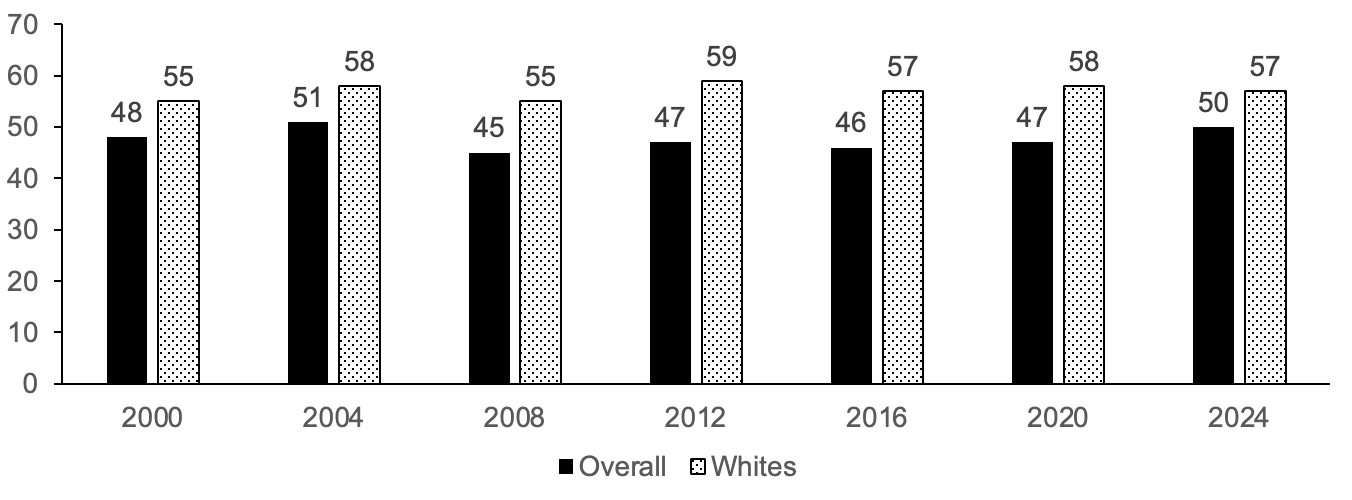
One clue comes from presidential vote shares in the 21st century. In the figure below, I have charted the overall Republican vote share and the Republican vote share among whites in each presidential election since 2000. There is clearly a lot of stability from election to election — presidential elections tend to be pretty close in this era. However, we see something very interesting about the 2012 election. That election saw the biggest rise — four percentage points — in the Republican presidential vote among whites from the previous election in the whole time series. The white vote share went from 55 percent to 59 percent between 2008 and 2012, while it dropped back down to 57 percent in 2016. The 2012 election also sees the biggest gap between the white vote share and the vote share of the rest of the country; whites voted 12 percentage points more Republican than the nation as a whole that year. That was only a 7-percentage point gap in 2024.
But those data are a bit blunt. Here’s a more detailed way of digging into the question. In the chart below, I examine the voting behavior of whites without a college degree. (This is only one way of defining “working class whites,” but it’s a useful one.) These numbers come from the American National Election Studies.
Keep reading with a 7-day free trial
Subscribe to Tusk to keep reading this post and get 7 days of free access to the full post archives.